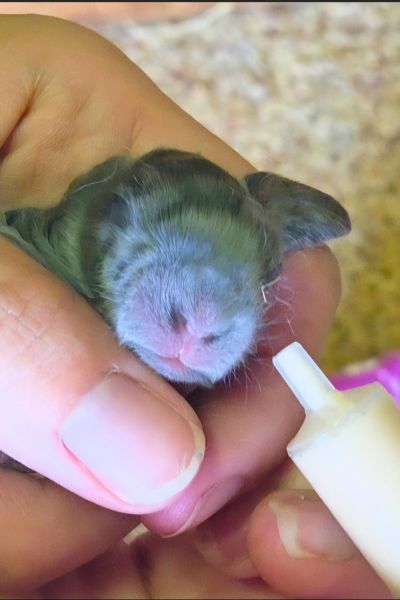
If you have a litter and one kit is falling behind, you have a narrow window to do something about it. Hand feeding a baby rabbit kit is not complicated, but the details matter. And after 16+ years of raising french lops there are some tricks and supplies that go against the norm but I have gotten far better results from.

The wrong milk, the wrong angle, or waiting too long will cost you that kit. I recently went through this with one of my French Lop litters and it is exactly what prompted me to put this together. Here is exactly what I do, what supplies I use, and how to know whether it is worth trying.
Supplies You Need To Hand Feed A Kit
Before you pull that kit out of the nest, have everything ready.
Whiskas Cat Milk
This is the one product I will not substitute. I do not use kitten milk replacer. I know that sounds backwards because kitten milk replacer has higher protein on paper, but in my experience every litter I attempted to raise on it wasted away and died.
It is too thin and they do not thrive on it. Whiskas cat milk is thicker, has more sugar, and gives kits the energy boost they need to keep fighting. Every kit I have hand fed on this product has gotten heavier, caught up with the litter, and survived. I have only ever needed to hand feed for a day or two before they were able to compete on their own again.
Whiskas cat milk comes in a three pack and does not need refrigeration until it is opened. Once opened, put a zip lock bag over the top and store it in the refrigerator. When you pull it out to use it, let it sit on the counter until it reaches room temperature. They will sometimes take it cool but you will get better results at room temp. Never microwave it. After the litter is done nursing I throw the remainder out. I often times just use one bottle of the three pack each litter.
AFFILIATE LINK: Whiskas Cat Milk
Syringes
You want syringes with a nozzle tip, not the kind designed to have a needle screwed onto them. The needle tip style is large to get into the kits mouth. You want something with a blunt tip that can wiggle gently into the side of the mouth without hurting the kit.
AFFILIATE LINK: Syringes
Paper Towels
Have these ready to dry the kit off after feeding before you put it back in the nest. You do not want a wet sticky kit sitting in the nest box getting chilled or dirt and debris stuck to it.
How To Know If A Kit Needs To Be Hand Fed
Before you pull anyone out, look at the whole litter first. You are looking for a few specific signs.
A kit that needs help will look noticeably smaller than its litter mates. The belly will be flat with no pudge to it. As the stronger siblings grow they compete harder at the nest and the smaller one gets pushed out.
The most serious sign is dehydration lines.
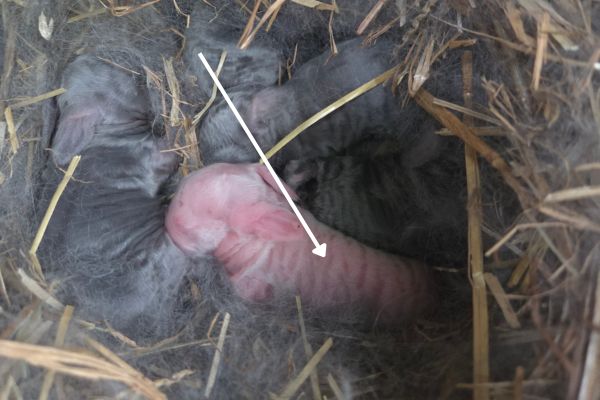
These are lines or wrinkles that run across the kit’s back and sides, going from left to right. When you see those, the kit is dehydrating and you have roughly 24-36 hours to act before it becomes very difficult to save.
If the belly is flat but you do not see dehydration lines, do not jump straight to hand feeding. The doe may simply not have fed yet. Feeding too early trains her body that she does not need to produce as much milk and you will create a bigger problem.
Wait and watch first if it is questionable if the kits are getting fed. Only step in when you are seeing real signs of decline.
If a kit is extremely thin, lying on its side, and appears to be opening its mouth like it is gasping, it is too far gone. It will likely be gone within hours. You can still try but the odds are very low at that point. You may not be able to get it to swallow and milk. The less energy they have the harder it is to save them regardless of what you do.
How To Hand Feed A Kit Step By Step
Step 1: Draw up the milk first
Pull about three milliliters into the syringe before you take the kit out. You will lose some in the feeding process so pulling a little extra means you are not fumbling to refill mid-feed.
Step 2: Hold the kit correctly
Pick up the kit and hold it in your non-dominant hand. Get it up into your fist so it cannot fight you as much. You can position it so the side of its face is almost against your palm to limit movement. Hold it at roughly a 35 to 45 degree angle, slightly on its back as if it were nursing, but not completely flat. You do not want it fully on its back because if milk runs out of its mouth it could drip into the nose from the outside. Keep that angle in mind throughout the feeding.
Step 3: Feed from the side of the mouth
Wiggle the syringe tip gently into the side of the mouth, not straight in from the front. Going in from the side is easier to manage and gets better results. Once the tip is just inside the opening of the mouth, dribble a small amount in and let the kit taste it. Keep the syringe in the mouth and wait until the mouth is mostly empty before dribbling in a little more. You are not pushing milk in. You are letting them take it in small amounts at their own pace.
Step 4: Keep going until they are done
Continue until the kit falls asleep, stops responding, or is fighting you hard enough that nothing productive is happening.
Even if they resist, if they are swallowing some of it keep going. This is for their survival, not their comfort. Do not feel bad about it.
A good first feeding is one to two milliliters. That is not much but for a 24hr old kit that size it is significant. You pulled three milliliters because you will lose some. Getting even that small amount into them is a win.
Step 5: Check the belly and dry them off
After feeding, look at the belly. If you can see any pudge at all you did your job. Do not stress about overfeeding. A kit with a very full belly from natural nursing looks enormous and they are fine. The only point where you back off is if you are seeing veins clearly through the skin of the belly. Otherwise get them as full as you can.
Dry the kit off with a paper towel and put it straight back in the nest with the rest of the litter.
The Complete Rabbit Care Guide: No Fluff, Just What Works
Housing, feeding, grooming, supplies, common health issues, and what to look for before you ever buy a rabbit. Practical care advice from a French Lop breeder with 18 years of hands-on experience. Nothing you do not need, everything you do.

How Often To Feed
Aim for twice a day, roughly twelve hours apart. You do not need to get up in the night. Does typically nurse once or twice a day naturally so you are supplementing, not replacing her.
As soon as you start seeing that kit gaining weight and competing better on its own, start backing off. The goal is to give it enough energy to survive until it can nurse successfully on its own. You are not trying to hand feed through the entire nursing stage. The sooner you can step back and let the doe take over fully the better.
Kits start showing interest in pellets around two and a half weeks and should be off milk by three to four weeks. If you are dealing with a kit that is two and a half weeks or older, offer pellets and see if it takes them. At that age they may not need supplemental feeding at all.
FAQ
What if milk gets in the nose?
Keep the kit at the right angle and this should not happen internally. The angle concern is about milk running out of the mouth and dripping into the nose from outside, which is why you avoid having them too flat on their back. If it does happen, turn the kit onto its stomach and let gravity help. There is not much else you can do given how small they are, so focus on preventing it in the first place.
Can you hand feed a kit that has never nursed at all?
The sucking motion comes naturally to them. You are just delivering milk to the side of the mouth and letting instinct take over.
How do you know when to stop trying?
If the kit is extremely thin, has no energy, and is lying on its side opening its mouth like it is gasping, it is likely too far gone. You can still try but be realistic. Before that point, if there is any energy at all it is worth attempting. What you are looking for is a kit that is thin and declining but still moving and responsive.
Hand feeding a kit is one of those skills you hope you never need but are glad you have when the moment comes. Situations like this are exactly why having your rabbitry systems and records dialed in matters. When something goes wrong you want to be focused on the animal, not scrambling to remember what doe this is or when she kindled.
If you are building a rabbitry you want to run like a real operation, the Profitable Rabbitry Playbook covers the systems, the herd management, and the business decisions that make the difference between a rabbitry that pays you back and one that quietly drains you. Grab it here.